
Part of the Short-Term Rental Management Guide, step 1: learn
Insurance: Three Things That Get Confused
1. Your Homeowners Policy
A standard homeowners policy is written for a home you or your family live in. Many policies limit or exclude "business" use, and nightly rentals can fall into that. Massachusetts put this in statute: under Chapter 175, section 4F, insurers that write homeowners and renters policies may exclude any and all coverage for claims resulting from a short-term rental, and an operator must give notice to its homeowners or renters insurer of the intent to rent.
Even outside Massachusetts, the safe course is the same: tell your agent in writing that you plan to rent short-term, and ask for the answer in writing.
2. A Short-Term Rental or Landlord Policy
Insurers sell policies built for short-term rentals, or endorsements that add rental use to a homeowners policy. When comparing them, ask about:
- Liability limits per occurrence, and whether they apply to guests and their visitors.
- Property damage by guests, including theft and vandalism.
- Loss of rental income after a covered loss, which matters in ski or lake season.
- Exclusions for hot tubs, saunas, docks, boats, fire pits, pets or parties.
- Vacancy rules for homes that sit empty in mud season.
- Off-platform bookings, since direct bookings are not covered by any platform program.
- Water and freeze damage, the costliest winter claim in an empty New England house.
3. Airbnb AirCover for Hosts
Airbnb describes AirCover for Hosts as included free with every booking on Airbnb. As of October 2026, it has two main parts:
| Part | What Airbnb says it does | Key limits |
|---|---|---|
| Host damage protection | Reimburses up to $3 million if guests damage your place or belongings, including some extra cleaning and lost income from canceled bookings | Airbnb says it "is not insurance." It excludes normal wear and tear, acts of nature, and normal checkout cleaning. You first request payment from the guest; you must file within 14 days of the responsible guest's checkout |
| Host liability insurance | $1 million in coverage if you are found legally responsible for a guest getting hurt or their belongings being damaged or stolen; also covers people who help you host, such as co-hosts and cleaners | Applies to stays booked on Airbnb only; excludes intentional acts; does not cover damage to your own property |
AirCover does not cover bookings on Vrbo, Booking.com or direct bookings, and the damage program is a reimbursement process rather than an insurance policy. Treat it as a backstop.
The Massachusetts $1 Million Rule
Chapter 175, section 4F requires a Massachusetts operator to carry liability insurance of not less than $1,000,000 for each short-term rental, unless the rental is offered through a hosting platform that maintains equal or greater coverage. Because Airbnb's program covers only Airbnb stays, owners who also list elsewhere or book directly should talk to their agent about meeting the requirement for every booking. More on our Massachusetts laws page.
Vermont's short-term rental statute asks the Department of Health and Division of Fire Safety to give operators an information packet that includes the importance of reviewing property and liability insurance with your insurer.
Smoke and Carbon Monoxide Alarms, by State
New Hampshire
RSA 153:10-a requires each rental unit to have automatic fire warning devices installed under the NFPA 101 Life Safety Code and NFPA 72, and carbon monoxide detection under NFPA 720. CO detection is not required if the unit has no attached garage and no appliance that burns solid, liquid or gas fuel, but becomes required if one is added. The owner of the rental unit is responsible for keeping them in working condition, and towns may adopt stricter rules.
Massachusetts
Chapter 148 of the General Laws covers smoke detectors in residential buildings (section 26E) and their inspection upon sale (section 26F). Section 26F1/2 requires every residential building with fossil-fuel burning equipment (a furnace, boiler, water heater or fireplace, for example) or enclosed parking to have working carbon monoxide alarms installed by the owner. Your local fire department can tell you what type and placement it expects.
Vermont
The Division of Fire Safety's short-term rental guidance, as of October 2026, calls for:
- Smoke alarms: photoelectric, near sleeping rooms, inside each sleeping room and on every level including the basement; newly installed alarms hard-wired.
- CO alarms: outside each sleeping area, inside any sleeping room with a fuel-burning appliance or fireplace, and on every occupied level, wired with battery backup.
- Occupant load: 8 people or less in a rented single dwelling unless the Division approves more through a change of use inspection.
- The checklist: complete the Division's Short-Term Rental Checklist and leave it visible in the rental.
Details are on our Vermont rules page.
Escape Routes and Posted Information
- Egress. Vermont requires a primary and secondary means of escape from every sleeping room (a window meeting rescue requirements can count) unless the building is sprinklered. In any state, do not advertise a room as a bedroom if guests could not get out a window in a fire. Finished basements and attic bunk rooms are the usual problem.
- Massachusetts posting rule. Every short-term rental must post inside the unit the locations of fire extinguishers, gas shut-off valves, fire exits and fire alarms.
- Vermont posting rule. Post a phone number for the person responsible for the unit, and contact information for the Department of Health and the Division of Fire Safety.
- Everywhere. Put the street address, the nearest hospital and how to reach you or your manager in the house manual. See best items for an Airbnb guidebook.
Fire Extinguishers
Massachusetts requires you to post where extinguishers are, which assumes you have them. A practical setup is an extinguisher in the kitchen and on each level, mounted where guests will see it, with the date checked at each turnover.
Hot Tubs, Saunas and Fire Pits
These are the amenities guests search for, and the ones insurers ask about.
- Hot tubs. Keep a locking cover on, post rules (no glass, no children unsupervised, time limits, no use after drinking), keep the water tested and treated between every stay, and ask your insurer whether it is covered.
- Saunas. Post clear instructions and a time limit, keep the heater guard in place, and keep towels and wood off the heater.
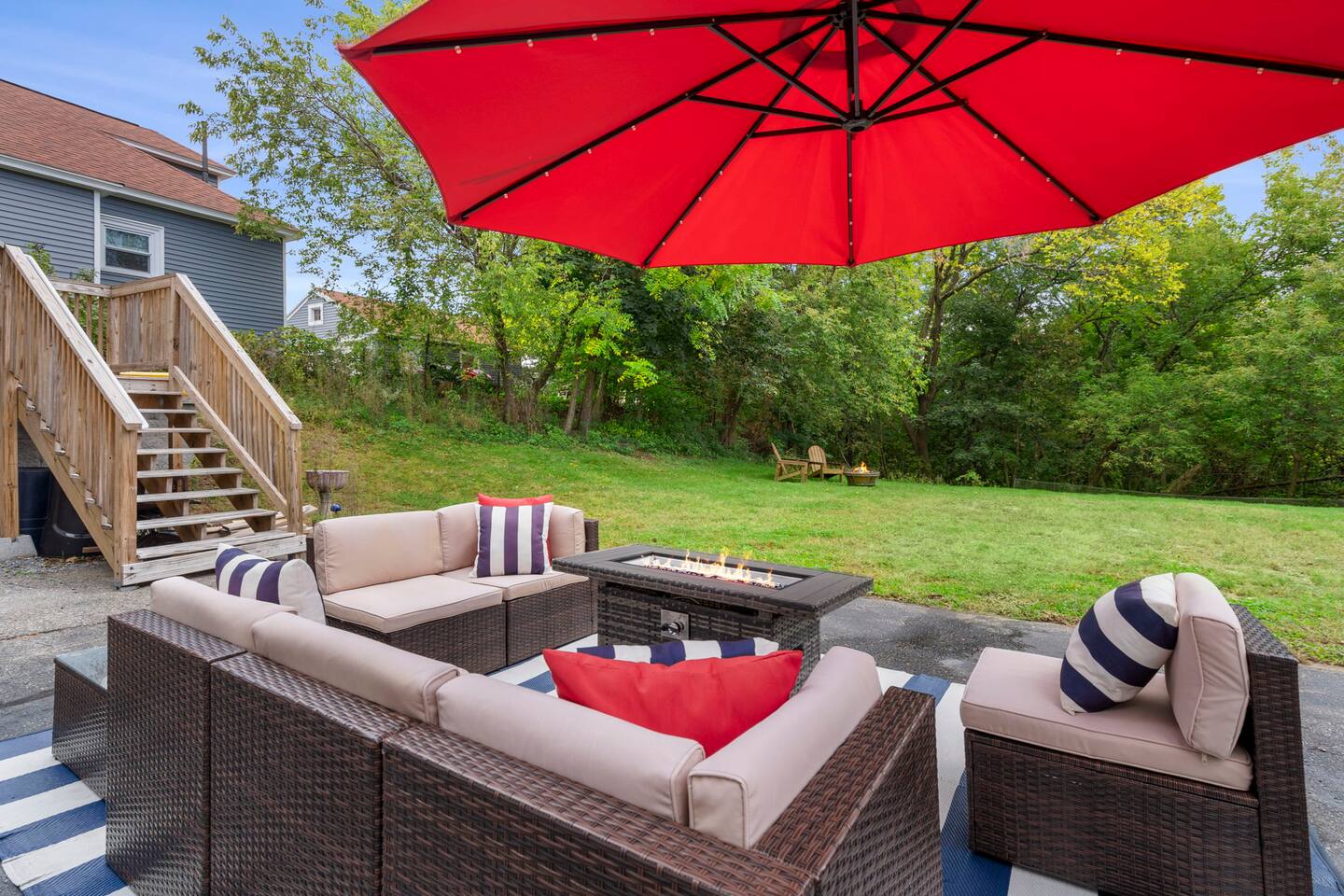
- Fire pits and outdoor fires. In New Hampshire, RSA 227-L:17 requires a written permit from the town's forest fire warden for most outdoor fires unless the ground is covered with snow, and camp or cooking fires need written permission from the landowner and the warden unless the town has equally strict rules of its own. Massachusetts and Vermont towns set their own burning rules; ask the local fire department. If you allow fires, give guests the rules and a bucket or extinguisher nearby.
- Wood stoves and fireplaces. Vermont asks for written instructions and a metal ash bin with a lid if guests may use them. That is good practice in every state.
Amenity ideas, with the work they create, are in best amenities that boost Airbnb bookings in New England.
Winter-Specific Safety
- Heat and freeze protection. An empty house between stays still needs heat, and a low-temperature alert helps catch a failed furnace before pipes freeze.
- Fuel. Oil or propane run-outs leave guests cold and can lead to frozen pipes. Vermont also requires fuel-fired heating systems to be inspected at least once every two years.
- Snow and ice. Plowed driveways, shoveled and salted steps, and roof snow over doorways are guest safety issues as well as access issues.
- CO risk. Snow can block exhaust vents for direct-vent furnaces and dryers. Clear them after storms.
Our winter rental management page covers the operational side.
Where New England Host Co Fits
New England Host Co's crews do housekeeping and an inspection after every stay, at the same visit, and the company coordinates repairs with an approval threshold agreed with each owner. Repairs, utilities and permit fees are paid by the owner. To ask about a specific home, use the contact page or start at the owner hub.
FAQ
Does My Homeowners Insurance Cover Airbnb Guests?
It may not. Many policies limit business use, and Massachusetts law expressly lets homeowners insurers exclude short-term rental claims. Tell your agent in writing and get the answer in writing.
Is Airbnb AirCover Insurance?
Partly. Host liability insurance is an insurance program with $1 million of coverage for stays booked on Airbnb. Host damage protection, up to $3 million, is a reimbursement program that Airbnb says is not insurance, with exclusions and a 14-day filing window.
What Does the Massachusetts $1 Million Rule Require?
At least $1,000,000 of liability coverage for each short-term rental, unless the platform you book through maintains equal or greater coverage, under Chapter 175, section 4F.
Do I Need Carbon Monoxide Alarms?
Almost certainly, if the home has any fuel-burning appliance or an attached garage. New Hampshire, Massachusetts and Vermont all require them in those cases, with Vermont specifying placement on every occupied level.
Can Guests Use the Fire Pit?
Check local rules first. In New Hampshire, most outdoor fires need a written permit from the town forest fire warden unless the ground is snow-covered. Give guests written rules if you allow it.
This page is general information as of October 2026, not legal or insurance advice; check with your insurer, your town or a professional before you list.
Sources
- AirCover for Hosts (Airbnb)
- Host damage protection (Airbnb Help Center)
- Host liability insurance (Airbnb Help Center)
- Chapter 337 of the Acts of 2018, including c. 175 section 4F (malegislature.gov)
- M.G.L. c. 148, section 26F1/2, carbon monoxide alarms (malegislature.gov)
- RSA 153:10-a (NH General Court)
- RSA 227-L:17, Fire permits (NH General Court)
- Short-Term Rental / Transient Lodging, Vermont Division of Fire Safety
- 18 V.S.A. section 4468, Educational materials (Vermont Legislature)